By, Allison R. Weder
After 15 years experiencing pain on and off, and struggling to step up stairs, Carl Shankweiler decided it was time to have knee replacement surgery. He remembers talking to the surgeon about the procedure. “They did an x-ray and it was bone-on-bone. I was certainly qualified to have it, and he felt that before I got any older, we should go ahead and do it.” The surgery was successful and the next step was to begin physical therapy sessions.
Everyone has the right to choose their Physical Therapist. Carl knows this and knew immediately where he wanted to go to rehabilitate his knee following surgery. He chose Phoenix Physical Therapy in Gratz, Pennsylvania. Not only have he and his wife used Phoenix PT-Gratz many times over the years, but Carl also takes advantage of the Phoenix Fit program. Phoenix Fit is available in many of the Phoenix clinics and allows a discharged patient to continue a maintenance exercise program. This program is individualized to the patient’s needs. Based on each facility’s available hours, a patient in the PHX FIT program is welcome to attend as often as desired or suggested by their Physical Therapist.
Anne Baney, a Physical Therapist from Phoenix Physical Therapy in Pottsville, Pennsylvania who occasionally sees patients in Gratz, performed Carl’s initial evaluation. She completed measurements, noted baseline ability, and spent time learning about Carl’s goals. After gathering all the information she needed, she collaborated with the Director of the Gratz clinic, Jason Pennypacker, PTA, C-PS. Together they produced a unique rehabilitation plan to get Carl back to doing the things he needs to do and loves to do.
The demanding work began immediately, and so did the pain. Carl reflects on how he felt in those first few days. “In the beginning, it seemed rather daunting or even hopeless. Because once the nerve blocks wore off, the pain was bad and they would want me to bend the knee more. The therapist would tell me you need to be able to move your knee. They would take measurements of how far I could go, and compared to that first day in the hospital, I could do less.” Carl was discouraged but grateful for the support from his therapy team. “It was concerning because I would hear stories about people who didn’t move their knees enough and then they had to have a kind of repeat surgery. But the therapists were realistic. They told me what I needed to do, but they were also respectful of my limitations. They would be working with my leg to try to get it to move. So, they were helping me to do it, and that’s what I think is so important. They were forceful and encouraging but also trying to work to make it possible for me to do the things that they wanted me to do.”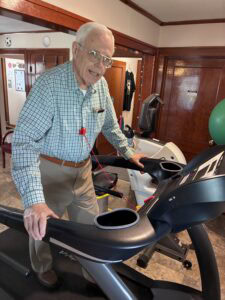
Carl worked through weeks of various exercises and stretches. “They would give me exercises where my foot was on a slider and then I would try to pull my foot back either just on my own or with a strap to see how far I could do it. I would sit on the edge of the bed, and they would work with my foot to try to push it back even further under me. They would also work with the leg using a disc to rub over the muscles.” Carl is talking about Instrument-assisted soft tissue mobilization (IASTM). It is a method clinicians use to effectively locate and treat areas of soft tissue dysfunction. Therapists use instruments to detect and treat areas of “scar tissue” or adhesions in muscles, tendons, and ligaments which can reduce range of motion and cause pain. Instruments effectively break down fascial restrictions and scar tissue. 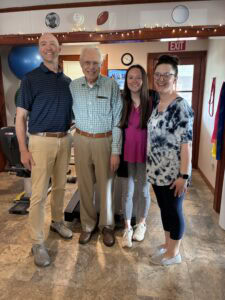
Carl began to see progress in the measurement updates and his ability to accomplish the exercises he previously could not do. “I would lie there and raise my leg. The leg had to be straight. In the beginning I couldn’t do that at all. But they said ‘It’ll come; it’ll happen,’ and sure enough, it did. There were a few exercises in the beginning I just couldn’t do at all, or the pain was too great. They would tell me I’d be able to do it, and it would happen all of a sudden. So, they’re not just scaring you, they’re encouraging you that yes, it will happen.” And many things did happen, including Carl’s ability to ride the stationary bicycle, which was one of his proudest achievements. “That was big. I felt I accomplished something when I did that. I could use the bicycle and not just go back and forth a little bit but actually go 360 degrees. I thought, if I can do this bicycle, even with weeks to go, I no longer felt I could end up having to go back for another operation.”
While another operation was not part of Carl’s future, a trip to Germany was. But would Carl be able to enjoy the trip that required walking miles each day? Carl lists the data from his fitness tracker. “Last Friday, 23,000 steps. Thursday, 18,507. Wednesday, 18,178. Tuesday in Prague, 25,908. Day before that, 13,068. 15,588. 13,902. 14,528. So, that’s proof right there. That was major walking, and I could do it. I was not as fast; I needed to take breaks, but I could do it.” Carl believes the time he spent with Jason, and his team made it possible. “I could not have done this without those therapists. Just telling me, ‘Do these exercises,’ that wouldn’t have cut it. They worked with my leg, they moved it, did things to try to help the muscles. They told me what I should do, but without their help and their encouragement, I would never have been able to do it. We had a lot of fun along the way. They’re nice people. They are nice, helpful people who are trying to make you better.” Jason knew Carl would succeed. “Carl never let early setbacks define his recovery. Through hard work, persistence, and commitment to his goals, he made great progress throughout his rehabilitation. His goal of traveling to Germany kept him motivated, and thanks to his dedication, he was able to enjoy the trip while walking many miles and creating many memories along the way. Anyone who knows Carl knows that hard work and perseverance are part of who he is. He brings a positive attitude and strong work ethic to everything he does, and his recovery was no different.”